Part 20 vs Part 90 Signal Boosters: What’s the Difference?
Understanding FCC Signal Booster Rules Without the Confusion
Poor signal has a way of showing up at the most inconvenient times, whether on a call, trying to download important documents, or running a business that depends on staying connected. Once you start looking for a solution, it doesn't take long before you run into terms like Part 20 and Part 90 signal boosters and wonder which solution applies to you.
Simply put, they are FCC categories that define what kind of network a booster can support. In this guide, we'll break down what each one means and how to choose the right fit for your space.
What Do “Part 20” and “Part 90” Actually Mean?
At first glance, Part 20 and Part 90 sound like technical jargon, but they're really just labels from the FCC's rulebook. Inside the Code of Federal Regulations Title 47, wireless communication is organized into numbered “Parts,” each one covering a different type of network and how it's allowed to operate.
The key difference comes down to the network itself. FCC Part 20 is for public cellular networks, the ones your phone connects to every day. FCC Part 90, on the other hand, applies to private networks, public safety, and industrial-grade radio equipment. Once you understand that split, the rest becomes much easier to navigate.
Who Each Type of Signal Booster Is For
- Part 20 signal boosters: For everyday cell phone users and businesses looking to improve signal on carriers like AT&T, Verizon, and T-Mobile
- Part 90 signal boosters: For organizations operating industrial-grade or private radio systems, such as public safety, utilities, and large-scale facilities
What Is a Part 20 Signal Booster?
Part 20 cell phone signal boosters are the most widely used category due to their effectiveness, accessibility, and deployment simplicity.
A Part 20 signal booster is designed to improve indoor cellular reliability and coverage by amplifying 4G LTE and low-band 5G signals from public carrier networks like AT&T, Verizon, and T-Mobile. Supported frequency bands typically include Band 12/17 (700 MHz), Band 13 (700 MHz), Band 5 (850 MHz), Band 4 (1700/2100 MHz), and Band 25 (1900 MHz).
Under FCC regulations, Part 20 boosters operate at a lower power level than Part 90 systems, with a maximum output of 1 watt. This limit helps ensure they don't cause harmful interference with nearby cellular networks, which is why they can be self-installed or deployed by standard installers without needing special rebroadcasting permits from carriers. Registration with your carrier is still required, but the process is straightforward.
You'll find Part 20 boosters used across both consumer and commercial environments, from homes and vehicles to offices and larger buildings. Most systems are designed for relatively easy installation, making them a practical option for improving indoor coverage without complex setup.
To stay compliant, all Part 20 boosters must be FCC-certified and include a clearly visible label, typically a sticker on the unit, confirming they meet regulatory requirements. If you're evaluating a system, this label is a quick way to verify that it's approved for use.
Brands like weBoost, SureCall, Nextivity, and WilsonPro offer a range of Part 20 solutions used by homeowners, RV travelers, small businesses, and enterprise teams alike. If you're trying to eliminate dead zones or create more consistent indoor coverage, this is the category you're looking for.
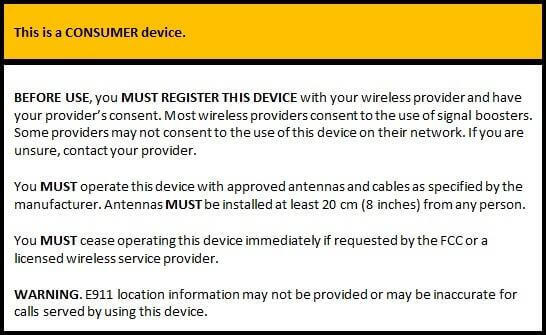
Featured Part 20 Signal Booster Solutions
Powerful and high-performing Part 20 commercial signal booster for enterprise environments with industry-leading gain up to 100 dB. Delivers reliable, scalable coverage (up to 200,000 sq. ft.) using Ethernet cabling throughout commercial spaces for up to three carriers.
Learn More
Part 20 commercial signal booster designed to enhance low-band 5G and 4G LTE coverage with up to 70 dB gain across spaces up to 100,000 sq. ft. using coax cabling. Supports all major US carriers.
Learn MoreShop our Top Part 20 Cell Phone Booster for Home, Vehicle, & Businesses
What Is a Part 90 Signal Booster?
Part 90 signal boosters are designed for more complex and large-scale communication needs. While they're often associated with public safety systems, they're not limited to that use. These boosters also support industrial-grade cellular coverage and private networking solutions across large commercial spaces.
Unlike Part 20 boosters, Part 90 systems operate at a higher power level, up to 5 watts. This added power allows them to cover much larger areas and support more demanding environments like hospitals, campuses, manufacturing facilities, transportation hubs, and high-rise buildings.
They can be used to improve communication across public safety frequencies, such as VHF, UHF, and 700/800 MHz bands, but many systems also support cellular networks from major carriers like AT&T, T-Mobile, and Verizon. Some solutions can even boost additional or customized frequency bands beyond what standard consumer systems handle.
Because of their higher power and broader capabilities, Part 90 boosters require a more involved deployment process. Re-broadcasting agreements must be obtained from carriers or network operators, which can take months. Professional design and installation by qualified RF professionals is required. While Part 90 solutions are available through specialized retailers, most setups begin with a consultation to ensure the system is properly configured for the space and network requirements.
In short, these are not plug-and-play solutions. They're built for environments where coverage is critical, scale matters, and performance needs go beyond what a standard Part 20 consumer or commercial booster can provide.
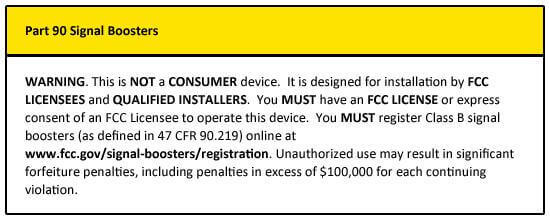
Featured Part 90 Signal Booster Solution
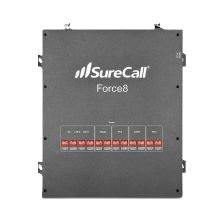
Basic industrial-grade Part 90 signal booster designed to enhance 5G/4G LTE connectivity in commercial spaces up to 80,000 sq ft. Features up to 80 dB gain and supports all major U.S. carriers.
Learn More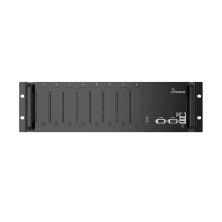
Part 90 solution pairing the WilsonPro 4330 booster with Zinwave's fiber-based DAS hardware to deliver reliable coverage across virtually any building, with support for public safety and private network integration.
Call for DetailsPart 20 vs Part 90 at a Glance
A side-by-side look at how Part 20 and Part 90 signal boosters differ:
|
Category |
Part 20 Signal Boosters |
Part 90 Signal Boosters |
|
Network Type |
Public cellular networks (AT&T, Verizon, T-Mobile) |
Public safety, private radio (PLMR), and cellular network solutions |
|
Who Uses Them |
Homeowners, businesses, vehicle owners, enterprises |
Public safety agencies, enterprises, utilities, large organizations |
|
Power Output |
Up to 1 watt (lower power, non-interfering) |
Up to 5 watts (higher power for large-scale coverage) |
|
Frequencies |
Standard cellular bands (4G LTE, low-band 5G) |
VHF, UHF, 700/800 MHz, plus some extended cellular or custom bands |
|
Where to Buy |
Retail stores, online, direct from manufacturers |
Authorized integrators & specialized vendors |
|
Regulations |
FCC-certified and carrier registration required |
FCC-certified with coordination, approvals, and rebroadcasting agreements required |
|
Installation |
Often DIY or light professional install |
Professionally designed and installed systems |
Which One Do I Need?
For most people, the answer is straightforward. If the goal is to improve basic connectivity for cellular devices using AT&T, Verizon, or T-Mobile, a Part 20 booster is a great fit. These are designed specifically for public cellular networks and are the right fit for homes, businesses, and vehicles.
Part 90 signal boosters are used in more complex and large-scale environments. While they do support private radio networks used by public safety and utilities, they're also used in large commercial and industrial spaces where greater power and broader coverage are required. If you're managing a large building, campus, or facility that needs a more robust, professionally designed system, a Part 90 solution may be the better fit.
If you're unsure which setup applies to your space or you're dealing with a more complex environment, it's worth getting a tailored recommendation. Our team offers full installation services for both commercial Part 20 and Part 90 systems, including turnkey solutions designed around your building and coverage needs. Call us at 1-800-420-3122 for a free consultation, and we'll help you find the right solution.
FAQs
All signal boosters must be FCC-certified to operate legally. Part 20 boosters also require registration with your carrier, while Part 90 systems typically need additional coordination and approval before they are turned on.
No. Part 20 signal boosters are designed for public cellular networks and do not support public safety or private radio frequencies. Those require a Part 90 solution.
Part 90 boosters are not intended for residential use. They are built for commercial, industrial, and public safety applications. Installation and operation must comply with specific regulatory requirements.
Part 20 boosters can often be installed with a straightforward setup, especially in homes or small offices, though larger systems may benefit from professional installation. Part 90 systems are more complex and typically require professional design, installation, and testing to meet regulatory and performance standards.