What drives the cost of a DAS solution in New York?
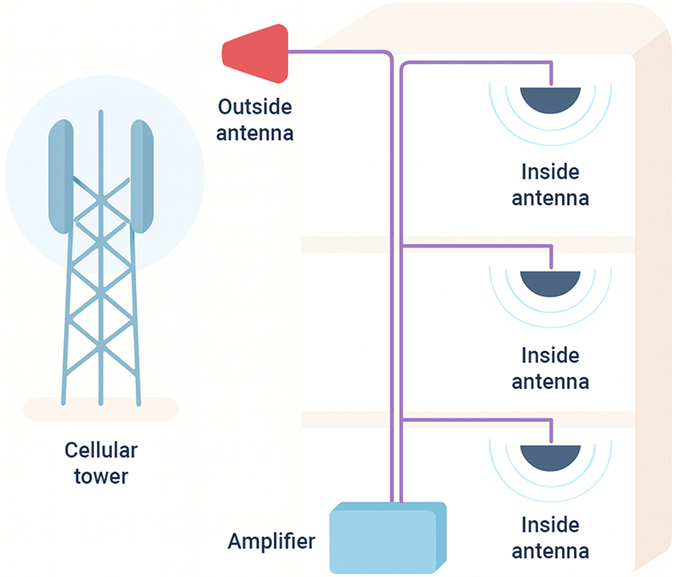
New York properties often involve complex engineering due to high-rise layouts, dense materials (steel, concrete, low-E glass), and heavy device usage.
Costs vary based on:
- Building size and height
- Number of carriers required
- Existing donor signal quality
- Whether public-safety DAS is needed
- Construction complexity and riser limitations
- Occupant density
Prices typically range from mid-five figures for smaller buildings to well into six figures for multi-floor or multi-building deployments. A detailed RF assessment is required to provide an accurate quote.
Are New York high-rise buildings more difficult for DAS installation?
Yes. New York high-rises present challenges not found in most states, such as:
- Narrow riser shafts
- Dense mechanical spaces
- Metalized glass that blocks RF
- Crowded telecom rooms
- Heavy structural steel
- Massive user density during peak hours
Our engineering teams design systems that overcome these obstacles using precise antenna placement, zoning, carrier balancing, and advanced modeling.
How long does a DAS installation take in New York?
Typical timelines include:
- RF Site Survey: 1–3 days
- iBwave Design & Carrier Readiness: 2–6+ weeks
- Carrier Approvals: 4–10 weeks
- Permitting (NYC especially): variable
- Installation: several days to 12+ weeks
- Optimization & Final Testing: ~1 week
High-rise and Class A buildings may require specialized scheduling around tenant occupancy and building operations.
Does DAS help in network-congested areas like Manhattan?
Absolutely. Manhattan, Brooklyn, Queens, and the Bronx often suffer from:
- Signal overload
- Building-to-building RF reflections
- Frequent carrier interference
- Oversaturated cell sectors
A DAS system stabilizes indoor wireless performance by delivering:
- Consistent voice quality
- Higher data throughput
- Fewer dropped calls
- Reliable emergency communication
Which industries in New York benefit the most from DAS?
DAS is especially valuable for:
- Hospitals and medical networks
- Corporate headquarters and financial institutions
- Hotels, convention centers, and luxury residential towers
- Universities and private schools
- Warehouses, ports, and industrial facilities
- Government and public-safety buildings
Any high-occupancy location with structural interference or high device density gains immediate benefit.
Do you support Verizon, AT&T, T-Mobile, and FirstNet?
Yes — New York’s primary carriers are fully supported. Our team handles:
- Multi-carrier engineering
- Interference mitigation
- Carrier submission packages
- On-site carrier testing and validation
Your system is built to maximize performance across all networks.
Do you provide public-safety DAS (BDA/ERRCS)?
Yes. We design and install systems that meet New York’s strict fire code requirements, including:
- Survivability standards
- NFPA and IFC compliance
- Battery backup
- Fire-rated pathway construction
- AHJ coordination
- Acceptance testing and full documentation
Public-safety DAS is often required for permits and certificates of occupancy.
Do you offer ongoing maintenance and monitoring?
Yes. Our maintenance services include:
- Annual code-required grid testing
- Carrier re-tuning
- Hardware upgrades
- Troubleshooting and repairs
- Remote monitoring options