How much does a DAS system cost in New Jersey?
DAS costs vary widely because New Jersey contains everything from pre-war buildings to state-of-the-art corporate campuses. Factors that influence pricing include:
- Building size and number of floors
- Dense materials such as brick, stone, concrete, and steel
- High device density in urban areas
- Carrier integration requirements
- Public-safety DAS and FirstNet radio needs
- Limited donor signal in waterfront or industrial regions
- Multi-building campus layouts
Most systems range from mid-five figures to well into six figures, depending on engineering complexity. A site survey and RF design are required for an accurate quote.
Do New Jersey high-rise buildings require different DAS engineering?
Yes. High-rise and mid-rise structures in Jersey City, Newark, and Hoboken often feature:
- Reinforced steel cores
- Underground parking levels
- Interior elevator banks
- Shielded conference rooms
- Energy-efficient glass
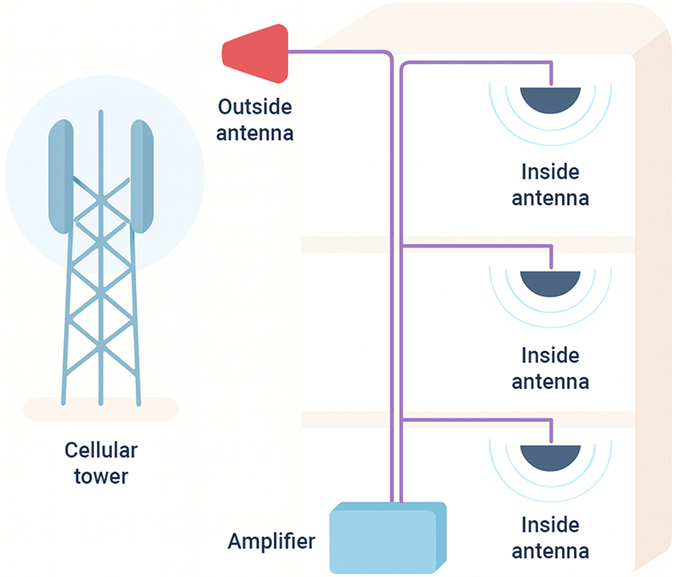
These features can severely disrupt cellular signals. DAS engineering compensates by:
- Placing antennas in signal-starved areas
- Using vertical riser pathways strategically
- Implementing zoning to manage capacity
- Ensuring performance during peak office hours
How long does installation take in New Jersey?
A typical timeline:
- RF Testing: 1–3 days
- iBwave Design: 1–4 weeks
- Carrier Approvals: 2–8+ weeks (depends on carrier workload)
- Permitting: varies by municipality
- Installation: several days to 12+ weeks
- Final Optimization: 1 week
Most New Jersey buildings are completed within 4–12 weeks from approval to commissioning.
Does a DAS help in areas with heavy urban congestion?
Absolutely. New Jersey’s proximity to New York City means many facilities deal with:
- High user density
- Signal noise
- Building shadows
- Network congestion
A DAS system stabilizes coverage inside the building, even during high-traffic periods, ensuring:
- Faster data
- Clearer voice quality
- Reduced dropped calls
- More reliable emergency communication
Which New Jersey industries benefit the most from DAS?
Industries with known connectivity challenges include:
- Hospitals and medical research centers
- Finance and corporate headquarters
- Shipping, logistics, and warehousing
- Higher education campuses
- Hotels, casinos, and waterfront venues
- Retail malls and entertainment complexes
- Pharmaceutical and biotech facilities
Any building with persistent indoor dead zones gains immediate value.
Do you support Verizon, AT&T, T-Mobile, and FirstNet in New Jersey?
Yes — New Jersey’s leading carriers are fully supported. We manage:
- Multi-carrier design
- Frequency coordination
- Testing and acceptance
- Carrier submission packets
Your system is built to accommodate both current and future network upgrades.
Do you install public-safety DAS (ERRCS/BDA) in New Jersey?
Yes. We handle:
- Engineering that meets New Jersey fire codes
- Fire-rated cabling and survivability requirements
- Battery backup and monitoring options
- AHJ coordination for inspections and sign-off
- Acceptance testing for first-responder radio channels
Public-safety DAS is often required during new construction or renovation.
Do you offer maintenance and ongoing support?
Yes. We provide:
- Annual compliance testing
- Troubleshooting and repair
- System tuning for carrier changes
- Replacement components
- Coverage expansion for remodeled spaces
Routine maintenance keeps your DAS functioning as networks evolve.