How much does a DAS system cost in Montana?
Costs vary widely depending on square footage, layout complexity, construction materials, and carrier requirements. Montana’s buildings often include metal agricultural structures, industrial warehouses, reinforced medical buildings, and multi-story commercial properties—all of which affect cabling routes and system design.
Key factors influencing price include:
- Distance from carrier towers (common in rural Montana)
- Heavy metal or concrete construction
- Multi-carrier integration (Verizon, AT&T, T-Mobile, FirstNet)
- Need for public-safety/ERRCS coverage
- Signal strength fluctuations due to mountainous terrain
- Ceiling height and floor count
Typical projects range from the mid-five figures to six figures, depending on scope.
Does Montana’s terrain impact DAS performance or design?
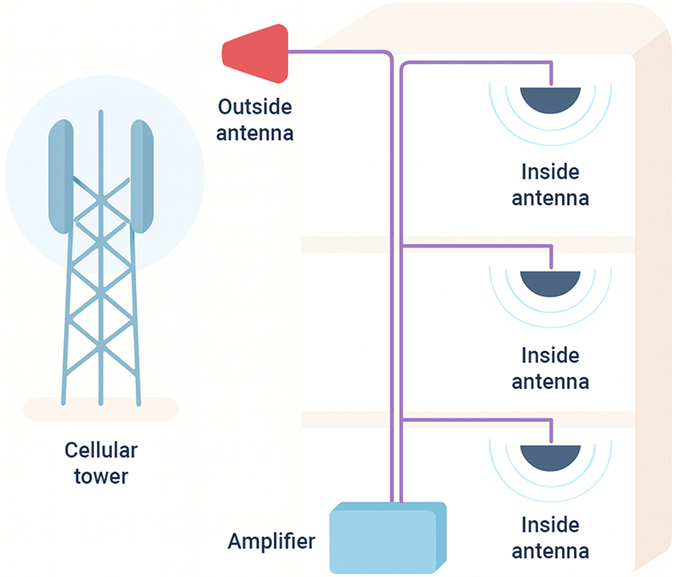
Yes. Montana’s mountains, valleys, and wide-open plains significantly affect outdoor signal reliability. DAS helps mitigate these challenges by:
- Capturing the strongest available donor signal
- Stabilizing indoor coverage even when outdoor towers fluctuate
- Compensating for difficult geography that prevents clean signal penetration
- Supporting reliable communication in remote areas
Facilities near ski resorts, industrial zones, and rural campuses benefit greatly.
How long does installation take for Montana facilities?
A standard timeline includes:
- RF Testing: 1–3 days
- iBwave System Design: 1–3 weeks
- Carrier Coordination: 2–6+ weeks
- Permitting (varies widely across counties): may add time
- Installation & Commissioning: several days to 12+ weeks
- Optimization: approximately 1 week
Most buildings are completed within 4–12 weeks, though ranch facilities, industrial plants, and large campuses may require additional time.
Is DAS effective in rural areas of Montana?
Yes. Many rural Montana buildings experience low outdoor signal due to distance from towers and rugged geography. DAS significantly improves indoor connectivity by:
- Amplifying the cleanest available outdoor signal
- Delivering uniform coverage throughout large structures
- Reducing dropped calls and slow data speeds
- Supporting IoT devices, automation, and workforce communication
This is especially valuable for agricultural operations, manufacturing facilities, ranch properties, and remote medical centers.
Which Montana industries benefit most from DAS?
Common sectors include:
- Healthcare and medical campuses
- Farming, ranching, and agriculture processing
- Manufacturing and logistics
- Tourism and hospitality (lodges, hotels, attractions)
- Government and emergency services
- Schools, universities, and technical institutions
Any facility with connectivity gaps or operational dependency on wireless communication is a strong candidate.
Do you support all major carriers in Montana?
Yes. Our DAS systems integrate with:
- Verizon (dominant in many rural areas)
- AT&T
- T-Mobile
- FirstNet for public safety
We manage the entire carrier-approval process.
Do you install public-safety DAS (ERRCS) in Montana?
Yes. We deploy systems that satisfy Montana fire-safety and emergency radio coverage requirements, including:
- First responder frequency testing
- Battery and survivability requirements
- Fire-rated cable pathways
- Alarm and monitoring integrations
- Coordination with local AHJs and fire inspectors
- Full documentation for approvals
This is especially important for hospitals, schools, government buildings, and large commercial structures.
Do you provide ongoing maintenance?
Yes. We offer:
- Routine inspections
- Monitoring (when supported)
- Retuning and optimization
- Hardware upgrades
- Expansion and troubleshooting
Maintenance ensures long-term performance, especially in regions with variable donor signal conditions.