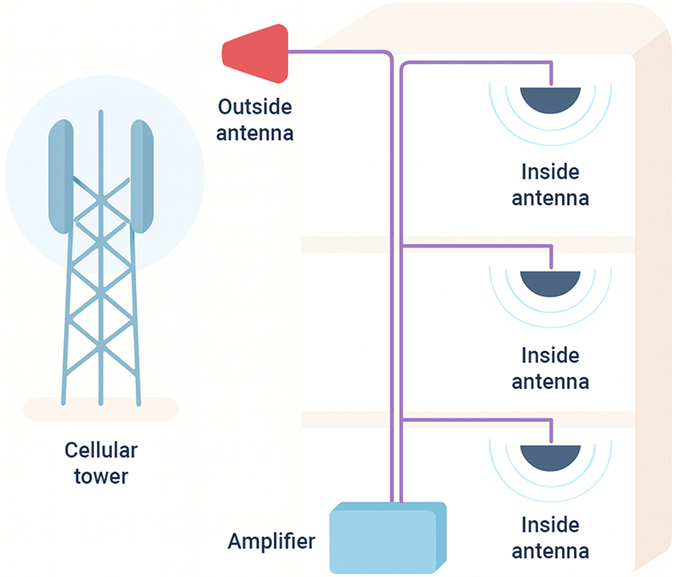
SignalBoosters.com delivers comprehensive Distributed Antenna System (DAS) solutions to businesses, institutions, and government facilities across Massachusetts. From Boston’s dense high-rises and historic buildings to Worcester’s medical campuses and the high-tech research corridor stretching through Cambridge, many facilities face significant indoor connectivity issues. Thick construction materials, legacy infrastructure, and heavy user demand often weaken signal inside. Our certified DAS engineers design, install, and optimize systems that deliver reliable LTE and 5G performance throughout every corner of your facility—supporting mission-critical communication, operational efficiency, and uninterrupted productivity.
Massachusetts buildings frequently struggle with cellular performance due to older architecture, energy-efficient materials, reinforced structures, and high device density—especially in Boston, Cambridge, and major university campuses. Coastal conditions, thick stone exteriors, and challenging winter weather patterns further impact outdoor coverage. A DAS system overcomes these obstacles by distributing strong indoor signal regardless of building age or layout.
Why Massachusetts organizations choose us:
Used in large, complex, or high-density environments such as hospitals, biotech labs, university buildings, and Boston high-rise offices. Provides robust, scalable performance for demanding wireless use.
Ideal for mid-sized buildings that require strong performance but do not need a full active system. Often used in manufacturing sites, government offices, hotels, and educational facilities.
A budget-friendly solution for smaller spaces including clinics, administrative buildings, retail stores, and older municipal structures that need consistent but moderate coverage improvements.
We begin by reviewing your wireless challenges, building layout, and carrier requirements.
Engineers conduct on-site testing to analyze real-time signal behavior and pinpoint structural barriers.
Using advanced modeling tools, we craft a coverage plan customized to your exact square footage, performance needs, and budget.
You’ll receive a clear breakdown of hardware, coverage goals, timelines, and pricing.
Bolton Install Pros handle cabling, equipment installation, optimization, safety compliance, and carrier coordination—ensuring your DAS meets Maryland performance and reliability standards.
Healthcare
Hospitals and specialty clinics across New York depend on strong signal for internal communication, telemedicine, and emergency response coordination.
Learn MoreCorporate & Financial Buildings
Manhattan and regional business hubs require stable wireless connectivity for employee workflows, tenant satisfaction, and high-density device use.
Learn MoreEducation
Universities, community colleges, and K–12 campuses rely on DAS for safety communication and modern learning environments.
Learn MoreHospitality & Multifamily
Hotels, luxury apartments, and convention venues require reliable coverage across elevators, basements, garages, and guest areas.
Learn MoreIndustrial & Logistics
Warehouses, ports, manufacturing centers, and distribution hubs need consistent signal for automation, tracking, and safety compliance.
Learn MoreWe provide DAS engineering, installation, and support across Massachusetts, including:
Don't See Your City or Neighborhood? Even if your city or neighborhood isn't listed, we still provide expert DAS solutions throughout Texas. Contact us today to discuss your in-building cellular needs.
We design and install DAS systems that eliminate weak indoor signal and provide dependable wireless coverage for Massachusetts businesses and institutions.
How much does a DAS system cost in Massachusetts?
Costs are influenced by building type, age, materials, layout, and the carriers you want supported. Massachusetts has some of the most demanding building environments in the country—historic stone structures, older brick buildings in Boston, and highly reinforced research facilities all impact project pricing.
Key pricing variables include:
Most Massachusetts DAS systems fall within the mid-five-figure to six-figure range. An onsite RF survey is required for accuracy.
How long does a DAS installation take in Massachusetts?
Typical project timeline:
Most Massachusetts facilities complete their DAS deployment within 4–12 weeks.
Does DAS work well in historic Massachusetts buildings?
Yes. Older buildings—especially in Boston, Salem, and New Bedford—are notorious for blocking cellular signal due to thick stone walls, metal reinforcements, and aging interior layouts. DAS is the most effective solution for:
The system distributes signal internally, bypassing issues caused by traditional materials.
Does DAS improve coverage in Massachusetts’ dense urban areas?
Absolutely. Boston, Cambridge, and Somerville have extremely high device density, causing indoor signal congestion and inconsistent performance. DAS improves:
It also reduces carrier strain inside large buildings.
Does DAS help in coastal or rural Massachusetts?
Yes. Coastal areas like Cape Cod and Martha’s Vineyard face challenges such as weather-related tower interference, seasonal user surges, and long tower distances. Rural regions west of Worcester also experience weak outdoor signal.
DAS stabilizes indoor coverage by:
Which carriers do your Massachusetts DAS systems support?
We design systems compatible with all major carriers in the state:
We also manage engineering submissions and carrier coordination.
What types of Massachusetts buildings benefit most from DAS?
Popular deployments include:
Any building experiencing weak, inconsistent, or blocked cellular coverage is a strong candidate.
Do you install public-safety DAS (ERRCS) in Massachusetts?
Yes. We install systems that comply with Massachusetts' interpretations of IFC and NFPA requirements, including:
Boston-area municipalities often enforce strict testing requirements, and we manage these on your behalf.
Do you provide maintenance and annual testing for Massachusetts DAS systems?
Yes. We offer:
This ensures peak performance and long-term reliability.