How much does a DAS system cost in Massachusetts?
Costs are influenced by building type, age, materials, layout, and the carriers you want supported. Massachusetts has some of the most demanding building environments in the country—historic stone structures, older brick buildings in Boston, and highly reinforced research facilities all impact project pricing.
Key pricing variables include:
- Dense, multi-floor layouts common in Boston and Cambridge
- Brick, stone, or concrete construction
- Carrier integration (Verizon, AT&T, T-Mobile, FirstNet)
- Whether public-safety/ERRCS coverage is required
- Difficult retrofit pathways in older buildings
- Equipment needed to overcome urban interference challenges
Most Massachusetts DAS systems fall within the mid-five-figure to six-figure range. An onsite RF survey is required for accuracy.
How long does a DAS installation take in Massachusetts?
Typical project timeline:
- RF Survey & Testing: 1–3 days
- iBwave Engineering: 1–3 weeks
- Carrier Coordination: 2–6+ weeks
- Permitting: Boston, Cambridge, and Newton may require additional public-safety review
- Installation: Several days to 12+ weeks depending on building size
- Final Testing: 3–7 days
Most Massachusetts facilities complete their DAS deployment within 4–12 weeks.
Does DAS work well in historic Massachusetts buildings?
Yes. Older buildings—especially in Boston, Salem, and New Bedford—are notorious for blocking cellular signal due to thick stone walls, metal reinforcements, and aging interior layouts. DAS is the most effective solution for:
- Museums
- Universities housed in historic buildings
- Government complexes
- Churches and auditoriums
- Older apartment and office buildings
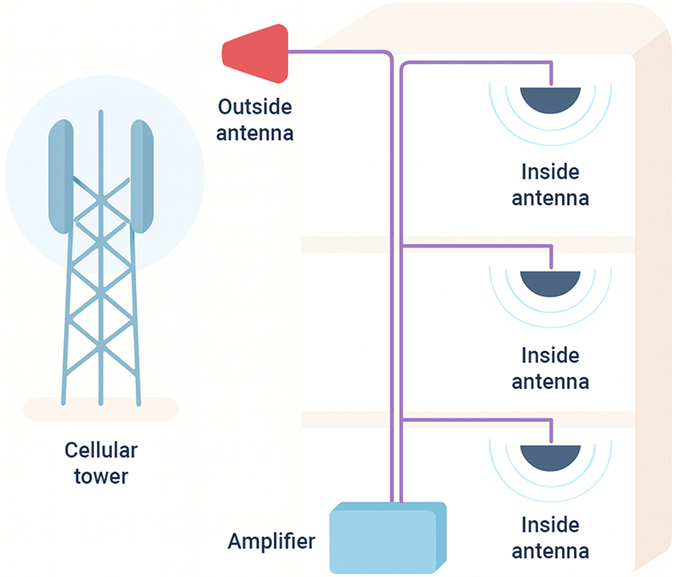
The system distributes signal internally, bypassing issues caused by traditional materials.
Does DAS improve coverage in Massachusetts’ dense urban areas?
Absolutely. Boston, Cambridge, and Somerville have extremely high device density, causing indoor signal congestion and inconsistent performance. DAS improves:
- Data throughput
- Voice reliability
- Coverage in elevator banks, stairwells, and underground levels
- Signal consistency across multiple floors
It also reduces carrier strain inside large buildings.
Does DAS help in coastal or rural Massachusetts?
Yes. Coastal areas like Cape Cod and Martha’s Vineyard face challenges such as weather-related tower interference, seasonal user surges, and long tower distances. Rural regions west of Worcester also experience weak outdoor signal.
DAS stabilizes indoor coverage by:
- Using directional donor antennas
- Prioritizing the strongest carrier signal
- Supporting multi-carrier redundancy
- Reducing reliance on fluctuating outdoor towers
Which carriers do your Massachusetts DAS systems support?
We design systems compatible with all major carriers in the state:
- Verizon (dominant in many areas)
- AT&T
- T-Mobile
- FirstNet for public-safety and hospital networks
We also manage engineering submissions and carrier coordination.
What types of Massachusetts buildings benefit most from DAS?
Popular deployments include:
- Hospitals and research centers
- Colleges and universities
- Biotech laboratories
- Commercial office buildings
- Hotels, convention venues, and event spaces
- Retail malls and multi-tenant properties
- Government and municipal buildings
- Coastal tourism properties
Any building experiencing weak, inconsistent, or blocked cellular coverage is a strong candidate.
Do you install public-safety DAS (ERRCS) in Massachusetts?
Yes. We install systems that comply with Massachusetts' interpretations of IFC and NFPA requirements, including:
- Signal validation for first-responder radio bands
- Fire-rated cabling
- Battery backup requirements
- Coverage guarantees for critical areas
- Compliance coordination with local inspectors and fire marshals
Boston-area municipalities often enforce strict testing requirements, and we manage these on your behalf.
Do you provide maintenance and annual testing for Massachusetts DAS systems?
Yes. We offer:
- Annual public-safety testing
- Periodic system health checks
- Remote monitoring (when supported)
- Repairs and upgrades
- Documentation updates for compliance
This ensures peak performance and long-term reliability.