How much does a DAS system cost in Maine?
Pricing varies based on facility size, building materials, and the carriers involved. Maine’s mix of older brick buildings, renovated historic structures, and modern commercial spaces means costs can differ widely. Remote towns may also require specialized donor antenna configurations due to tower distance.
Factors influencing cost include:
- Square footage and floor complexity
- Exterior wall materials common in Maine (brick, stone, reinforced concrete)
- Carrier requirements: AT&T, Verizon, T-Mobile, FirstNet
- Code-driven public-safety needs
- Cable routing complexity in older buildings
- Challenges created by thick coastal construction methods
Most projects in Maine fall in the mid-five-figure to six-figure cost range. A detailed site survey provides exact pricing.
How long does a DAS installation take for Maine facilities?
Timeline depends on building size, carrier involvement, and permitting requirements, but most projects follow a predictable structure:
- RF Survey: 1–3 days
- iBwave Design: 1–3 weeks
- Carrier Coordination: 2–6+ weeks (depends on carrier response times)
- Permitting: Some Maine municipalities require additional review for public-safety systems
- System Installation: Several days to 12+ weeks depending on size
- Final Testing: 3–7 days
Typical Maine DAS projects take 4–12 weeks from start to finish.
Is DAS effective in Maine’s rural and coastal areas?
Yes. Maine’s rural regions and coastal environments are known for sparse tower coverage and challenging terrain. DAS helps stabilize indoor connectivity even when outdoor signal is inconsistent.
To support these areas, we often use:
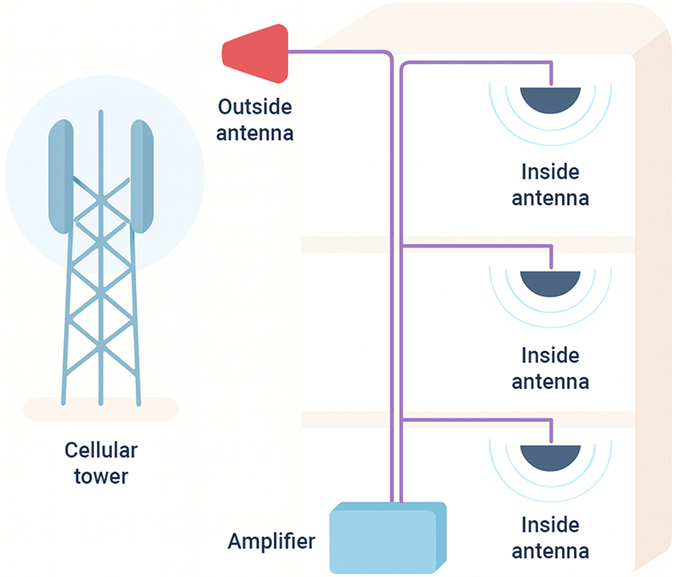
- High-gain donor antennas
- Directional antenna tuning to reach distant towers
- Multi-carrier design for better reliability
- RF modeling that accounts for terrain elevation and coastal interference
DAS significantly improves indoor performance in hospitals, warehouses, hotels, and municipal buildings located far from dense tower networks.
Does DAS support Maine’s healthcare and educational sectors?
Absolutely. Healthcare and education are two of the strongest use cases in Maine.
Healthcare
- Improves communication between staff, emergency teams, and monitoring systems
- Covers concrete-heavy diagnostic areas
- Ensures connectivity for visitors and patients
Education
- Provides stable coverage for classrooms, libraries, labs, and residence halls
- Supports high-density student usage
- Helps campus safety teams maintain reliable communication
Which carriers do your DAS systems support in Maine?
Our DAS solutions are compatible with all major carriers in the state:
- Verizon (strong statewide presence)
- AT&T
- T-Mobile
- FirstNet for public-safety agencies
We handle engineering submissions and approvals required for each carrier.
Which Maine buildings benefit most from DAS?
Common projects include:
- Medical centers and urgent care facilities
- Universities and K–12 schools
- Tourism and hospitality properties
- Industrial facilities and warehouses
- Multi-tenant office buildings
- Government buildings and emergency response centers
- Marine and coastal operations facilities
Any building experiencing indoor coverage gaps is a strong candidate.
Do you provide public-safety DAS installation for Maine buildings?
Yes. We install Emergency Responder Radio Communication Systems (ERRCS) that satisfy Maine fire code requirements, including:
- Adequate coverage for first-responder radio bands
- Fire-rated cabling and survivability standards
- Battery backup systems
- Coordination with local AHJs and inspectors
- Final acceptance testing and documentation
Public-safety DAS is especially important in large buildings, hospitals, schools, and renovated historical facilities.
Do you offer maintenance and annual testing in Maine?
Yes. Our services include:
- Routine system health checks
- Annual and semi-annual compliance testing
- Remote monitoring options
- On-demand repairs
- Updated documentation and reporting
This ensures the DAS system continues operating at peak performance.