How much does a DAS system cost for Louisiana buildings?
Costs depend on the building’s structure, square footage, and the carriers that must be supported. Louisiana has a wide range of facilities—from century-old French Quarter buildings to heavy industrial complexes along the Gulf Coast. Brick, steel reinforcement, hurricane-rated materials, and large floorplans all influence pricing.
Key cost considerations in Louisiana include:
- Presence of metal equipment in industrial sites
- Thick masonry or hurricane-resistant walls
- Multi-building or campus layouts
- Carrier requirements (Verizon, AT&T, T-Mobile, and FirstNet)
- Public-safety/ERRCS obligations
- Difficulty of cable routing in older or retrofitted buildings
Most Louisiana DAS projects fall within the mid-five-figure to six-figure range. Accurate pricing requires a site survey and custom iBwave design.
How long does a DAS installation take in Louisiana?
Project durations vary by building type and required carrier approvals, but most Louisiana deployments follow these stages:
- Signal Walkthrough & Data Collection: 1–3 days
- Engineering & iBwave Design Creation: 1–3 weeks
- Carrier Coordination: 2–6+ weeks, depending on responsiveness
- Permitting: Coastal cities like New Orleans often require additional documentation
- Installation Phase: A few days for smaller offices; 8–12+ weeks for large industrial or multi-structure facilities
- Commissioning & Testing: 3–7 days
Total project time often ranges between 4 and 12 weeks.
Does DAS work well in coastal Louisiana where hurricanes affect cell service?
Yes. While coastal conditions and weather patterns can impact tower performance, DAS is built to stabilize indoor connectivity. Our designs account for:
- Outdoor signal fluctuations
- Reinforced building materials used for wind and flood protection
- Congestion spikes during emergencies or evacuation periods
- Carrier diversity (often crucial in storm-prone areas)
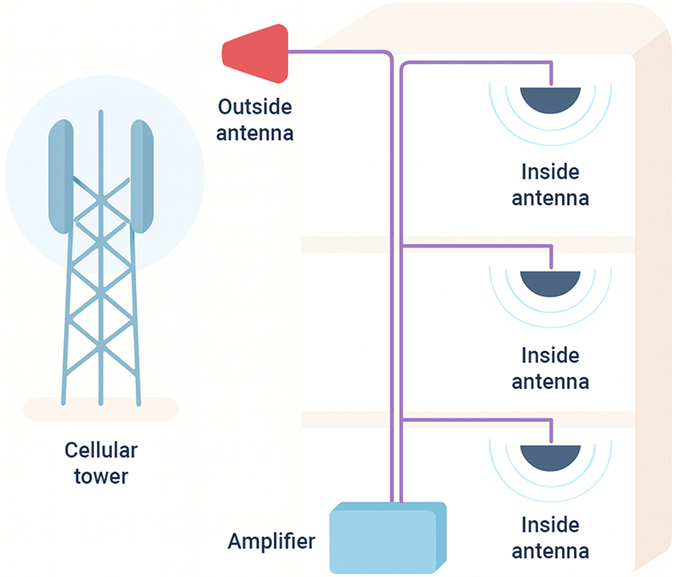
DAS distributes signal internally, ensuring your building maintains reliable coverage even when outdoor conditions vary.
Can DAS support Louisiana’s refineries and industrial plants?
Absolutely. Many Louisiana industrial sites struggle with wireless communication due to steel structures, large equipment, and harsh environments. DAS is ideal for:
- Control rooms
- Administrative offices
- Processing areas
- Maintenance facilities
- Remote monitoring stations
Systems can be designed to support IoT devices, workforce communications, scanners, and safety-critical tasks.
What carriers can your DAS solutions support in Louisiana?
We design systems that work with all major carriers operating across the state:
- AT&T (particularly strong across southern Louisiana)
- Verizon
- T-Mobile
- FirstNet for public-safety and emergency response
We handle all documentation required for carrier acceptance testing.
Which Louisiana buildings benefit most from DAS?
Typical Louisiana DAS clients include:
- Hospitals and medical centers
- Oil, gas, and petrochemical plants
- Riverport and logistics facilities
- Universities and community colleges
- Hotels, casinos, and convention spaces
- Government buildings and emergency operations centers
- Multi-tenant commercial buildings
Any building with weak, inconsistent, or blocked signal can benefit from a DAS system.
Do you offer public-safety DAS installations in Louisiana?
Yes. We deliver fully compliant public-safety DAS solutions that meet Louisiana’s interpretation of IFC and NFPA codes. Services include:
- First-responder communication testing
- Fire-rated cable installation
- Battery backup systems
- Critical-area coverage verification
- Coordination with local fire marshals and AHJs
Many parishes enforce strict ERRCS standards—our team ensures full compliance.
Do you provide ongoing maintenance and system testing?
Yes. We offer:
- Annual and semi-annual public-safety testing
- Preventative maintenance programs
- Remote system monitoring (when supported)
- On-demand troubleshooting and repairs
- Full documentation and system reporting
This ensures long-term performance and compliance with Louisiana safety regulations.