How much does a DAS system cost in Indiana?
DAS pricing varies widely because Indiana buildings span everything from 20,000 sq. ft. medical clinics to multi-building industrial campuses. Key cost factors include:
- Building square footage and ceiling height
- Steel, concrete, or brick construction (common in Indiana manufacturing and university buildings)
- Number of floors and stairwells
- Whether the system must support Verizon, AT&T, and T-Mobile simultaneously
- Public safety / ERRCS requirements mandated by local AHJs
- Installation complexity in older or renovated structures
Small to mid-size buildings typically fall in the mid-five-figure range, while large or multi-tenant sites often require low-to-mid six-figure budgets. Final pricing is determined after an RF survey and iBwave design.
How long does DAS installation take in Indiana?
Timelines depend on building size, carrier approvals, and design complexity. Typical Indiana projects follow these phases:
- On-Site Survey: 1–3 days (longer for industrial plants or large campuses).
- iBwave Design: 1–3 weeks depending on complexity.
- Carrier Coordination: 2–6 weeks for multi-carrier approvals, shorter for Verizon/AT&T single-carrier systems.
- Permitting: Varies by city — Indianapolis and Fort Wayne can require additional review for public-safety systems.
- Installation: Ranges from several days to 8–12+ weeks for large industrial sites or hospitals.
Most commercial buildings fall within a 4–12 week total project duration.
Do DAS systems work in rural or semi-rural Indiana?
Yes. Large areas of Indiana — including regions outside Kokomo, Columbus, Richmond, and Terre Haute — have wide tower spacing and challenging indoor penetration. DAS works effectively in these areas because:
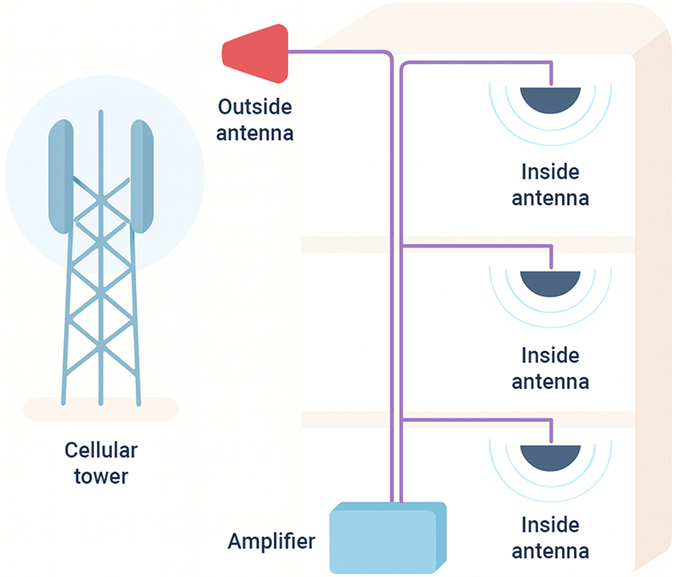
- We pull donor signal from the strongest nearby tower
- Directional antennas are optimized specifically for rural propagation
- iBwave design compensates for weak outside signal
- Systems can be engineered to serve critical operations even with low tower density
Many manufacturing plants, schools, and distribution centers in rural Indiana rely heavily on DAS.
Which carriers are supported in Indiana DAS installations?
We offer carrier-neutral designs that support:
- Verizon
- AT&T
- T-Mobile
- FirstNet (when applicable)
Carrier coordination is handled by our engineering team, and we manage submissions, test results, and acceptance documentation for Indiana builds.
What building types benefit most from DAS in Indiana?
Based on location-specific patterns, the most common deployments include:
- Hospitals & medical centers — cellular signal often fails through thick concrete wings.
- Steel manufacturing plants — metal structures create severe reflection and signal loss.
- Distribution hubs — reliability is critical for scanners and automation.
- Corporate and government buildings — ensure consistent connectivity for internal teams.
- Higher education & K-12 — multi-level buildings and dorms frequently have dead zones.
- Hotels, casinos & event venues — require seamless guest connectivity.
If your building experiences dropped calls or slow data inside, DAS is usually the correct solution.
Do you provide public-safety / ERRCS systems in Indiana?
Yes. We design and install Emergency Responder Radio Coverage Systems (ERRCS) that meet Indiana’s AHJ requirements. Our services include:
- Coverage testing for first-responder bands
- Code-compliant system design
- Coordination with local fire marshals and inspectors
- Acceptance testing and documentation
- Ongoing monitoring and maintenance options
Public-safety systems often require stricter performance standards, especially in high-occupancy buildings or new commercial construction.
Who handles maintenance after installation?
You can choose between:
- A full mintenance plan (recommended for hospitals, logistics centers, and multi-carrier systems)
- On-demand service as needed
- Remote monitoring options depending on system type
We provide documentation, acceptance reports, and post-installation support for all Indiana customers.