Georgia’s buildings—from Atlanta’s high-rise offices to Savannah’s historic structures and Augusta’s industrial facilities—often struggle with weak indoor cellular connectivity due to thick brick, steel framing, dense construction, and heavy wireless traffic. SignalBoosters.com delivers engineered Distributed Antenna Systems (DAS) that bring reliable LTE and 5G coverage inside every critical area of your building.
Whether you’re managing a corporate tower, a hospital campus, a university facility, or a manufacturing operation, our DAS experts design carrier-approved solutions tailored to Georgia’s construction styles, climate conditions, and high device usage.
Georgia has one of the fastest-growing commercial and residential markets in the Southeast, creating constant strain on cellular networks. Urban density in Atlanta, older brick buildings in Savannah, sprawling manufacturing plants in Macon, and multi-level healthcare facilities statewide all face severe indoor signal loss. Add Georgia’s rolling terrain, tree canopy, and rapidly expanding device usage, and outdoor towers simply cannot keep up.
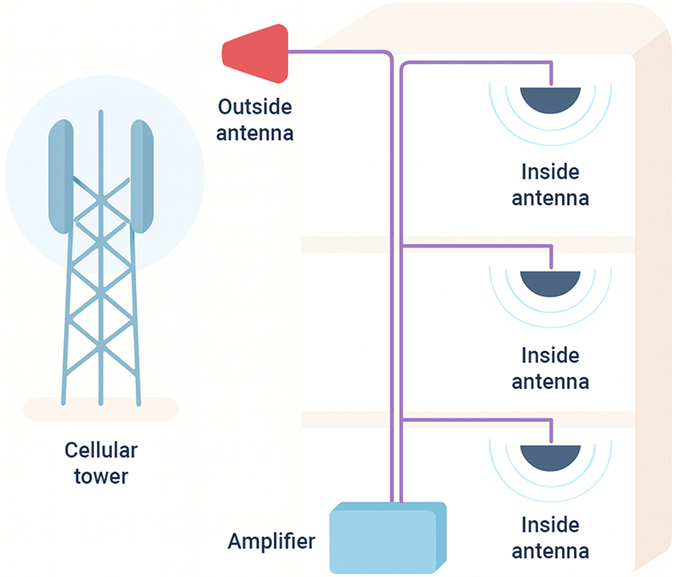
A properly engineered DAS overcomes these challenges by distributing strong, consistent cellular coverage across your entire building—improving safety, productivity, patient care, and customer experience.
Designed for Georgia’s high-capacity environments such as airports, major hospitals, universities, and corporate campuses. Offers unmatched multi-carrier performance and scalable architecture.
A smart middle-ground solution suited for mid-size commercial buildings, research facilities, hotels, and industrial spaces where balanced performance and affordability are key.
Ideal for smaller structures like municipal buildings, retail stores, K–12 schools, and small healthcare centers. Budget-friendly and highly effective for targeted coverage improvement.
We begin by understanding your building’s operational demands, safety requirements, and coverage gaps.
Our engineers map your building’s real signal conditions, identifying dead zones, interference sources, and carrier performance issues.
We deliver a detailed engineering package outlining antenna placement, cable routing, coverage heatmaps, and expected performance.
Every proposal includes transparent pricing, expected results, and a realistic deployment schedule.
Bolton Install Pros deploy your system with clean cabling, safety compliance, and carrier testing to ensure it performs flawlessly.
Georgia’s diverse economy relies heavily on dependable indoor connectivity. We design and install DAS for:
Healthcare
Healthcare facilities often need reliable cellular coverage to ensure staff, patients, and first-responders can communicate - even in basements, thick-walled wings or high-density wings.
Learn MoreCommercial & Office Real Estate
As many businesses rely on mobile devices and real-time communications, companies need robust connectivity for employees, visitors, and operations - DAS provides that.
Learn MoreHospitality
Hotels and resorts often implement DAS to ensure guests have reliable cellular coverage throughout the property - including basements, parking garages, and interior rooms.
Learn MoreIndustrial, Warehousing & Large-Scale Commercial Campuses
Many industrial operations adopt IoT, automation, private LTE/5G, and digital coordination. Reliable coverage provided by DAS becomes more critical.
Learn MorePublic Safety &Government Facilities
Buildings that must support first-responder communications - like government offices, schools, large residential buildings, public-safety stations - frequently use DAS to meet building codes and safety requirements.
Learn MoreWe offer DAS engineering, installation, and support in every major Georgia region, including:
Each city receives a site-specific approach tailored to construction materials, local carrier performance, and operational needs.
Don't See Your City or Neighborhood? Even if your city or neighborhood isn't listed, we still provide expert DAS solutions throughout Texas. Contact us today to discuss your in-building cellular needs.
Our DAS projects range from complex multi-carrier systems to compact passive deployments:
Give your building dependable LTE and 5G coverage engineered specifically for Georgia’s climate, materials, and carrier landscape.
How much does a DAS system cost in Georgia?
Costs vary based on square footage, floor count, building materials, and how many carriers you need. Georgia’s high-rise offices, medical facilities, airport hubs, and industrial plants often require more extensive cabling and multi-carrier integration, which can raise costs. Smaller buildings may start in the low tens of thousands, while larger or multi-building systems often fall into the mid–six figures. A full RF survey and iBwave-certified design are needed for accurate pricing.
Why does Georgia have so many indoor cell coverage issues?
Several factors contribute:
DAS brings strong indoor coverage directly into your building, bypassing these external limitations.
Does DAS help in rural or mountainous Georgia regions?
Yes. North Georgia’s elevation, rolling hills, and wooded terrain can significantly weaken outdoor signal. A properly engineered DAS uses donor antennas and smart distribution to deliver strong indoor connectivity even when outdoor coverage is inconsistent.
Do you support all major carriers in Georgia?
Absolutely. Our DAS systems support AT&T, Verizon, T-Mobile, and relevant 5G and LTE bands. We manage carrier coordination, design approvals, and final testing so your system is fully validated.
Which Georgia buildings benefit most from DAS?
Common candidates include:
Any facility where communication affects safety, operations, or customer experience will benefit from DAS.
Do you install Georgia public-safety DAS (ERRCS/BDA)?
Yes. We engineer ERRCS/BDA systems that meet Georgia fire code and AHJ standards. Services include RF testing, code-compliant design, fire marshal coordination, acceptance testing, and annual recertification.
Who provides maintenance and monitoring for Georgia DAS systems?
We offer optional maintenance packages, including system health checks, RF rebalancing, component replacement, and ongoing support—especially valuable for large, multi-carrier systems or facilities with high user density.