How much does a DAS system cost in Connecticut?
Pricing depends on building size, materials, number of carriers, and coverage requirements. Connecticut buildings often feature thick brick masonry, reinforced concrete, and high-efficiency window systems—materials that significantly reduce indoor signal penetration. Small commercial buildings may begin in the low tens of thousands, while large hospitals, universities, and multi-floor corporate buildings may require six-figure budgets. Facilities in dense areas like Stamford, New Haven, and Hartford may also require additional capacity engineering due to heavy device usage. A site survey and iBwave-certified design are required for accurate cost modeling.
Why do Connecticut buildings struggle with cellular connectivity?
Many Connecticut structures—especially hospitals, universities, corporate towers, and historical buildings—use:
- Thick stone and brick walls
- Reinforced concrete foundations
- Metal framing
- Low-emissivity glass
- Dense underground levels
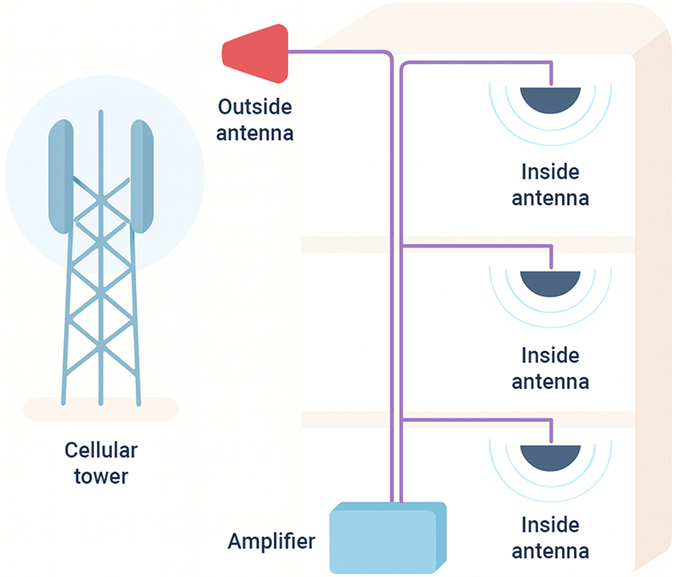
These materials block cellular signals entirely. DAS provides a controlled indoor signal distribution system that eliminates dead zones and maintains consistent connectivity across all floors.
Does DAS work in Connecticut’s older and historic buildings?
Yes. Connecticut has many older facilities whose construction materials severely impede wireless communication. DAS allows us to deliver strong indoor coverage without altering architectural integrity. Our engineering process ensures:
- Minimal disruption
- Hidden cable pathways where possible
- Compliance with preservation requirements
- Non-invasive antenna placement
This is critical for universities, historic hospitals, and legacy office properties.
Do you support all major carriers in Connecticut?
Yes. Our DAS systems are carrier-neutral and support AT&T, Verizon, T-Mobile, and all required LTE/5G frequencies. We manage design submissions, carrier approvals, optimization, and on-site acceptance testing. In dense CT tech and finance hubs, we engineer for heavier capacity; in suburban regions, we optimize for broader coverage and stronger donor-signal capture.
Which Connecticut buildings benefit most from DAS?
DAS is ideal for:
- Hospitals & large medical centers
- Educational institutions, research labs & university campuses
- Financial headquarters & insurance campuses
- Mixed-use commercial towers & office buildings
- Aerospace & precision manufacturing sites
- Government and public-safety facilities
- Hotels, casinos & entertainment venues
Any building with connectivity challenges or high occupancy is an excellent candidate.
Do you install public-safety DAS (ERRCS/BDA) in Connecticut?
Yes. We install Emergency Responder Radio Coverage Systems (ERRCS/BDA) that meet Connecticut building and fire code requirements. Our services include:
- RF testing for fire, EMS, and police frequencies
- AHJ coordination with Connecticut fire marshals
- Code-driven system design and documentation
- Acceptance testing, commissioning & occupancy certification
- Optional annual inspections and re-certification
Public-safety communication is legally required in many new and renovated structures across the state.
Who handles maintenance after installation?
We offer scheduled maintenance plans, annual compliance checks, remote monitoring, and on-demand service. Connecticut facilities experiencing high traffic, multi-carrier usage, or complex building layouts often benefit from ongoing support to maintain peak system performance and code compliance.